
A Modern Monetary Framework: 12 Core Principles
Foundational Rules for a Reality-Based Economy

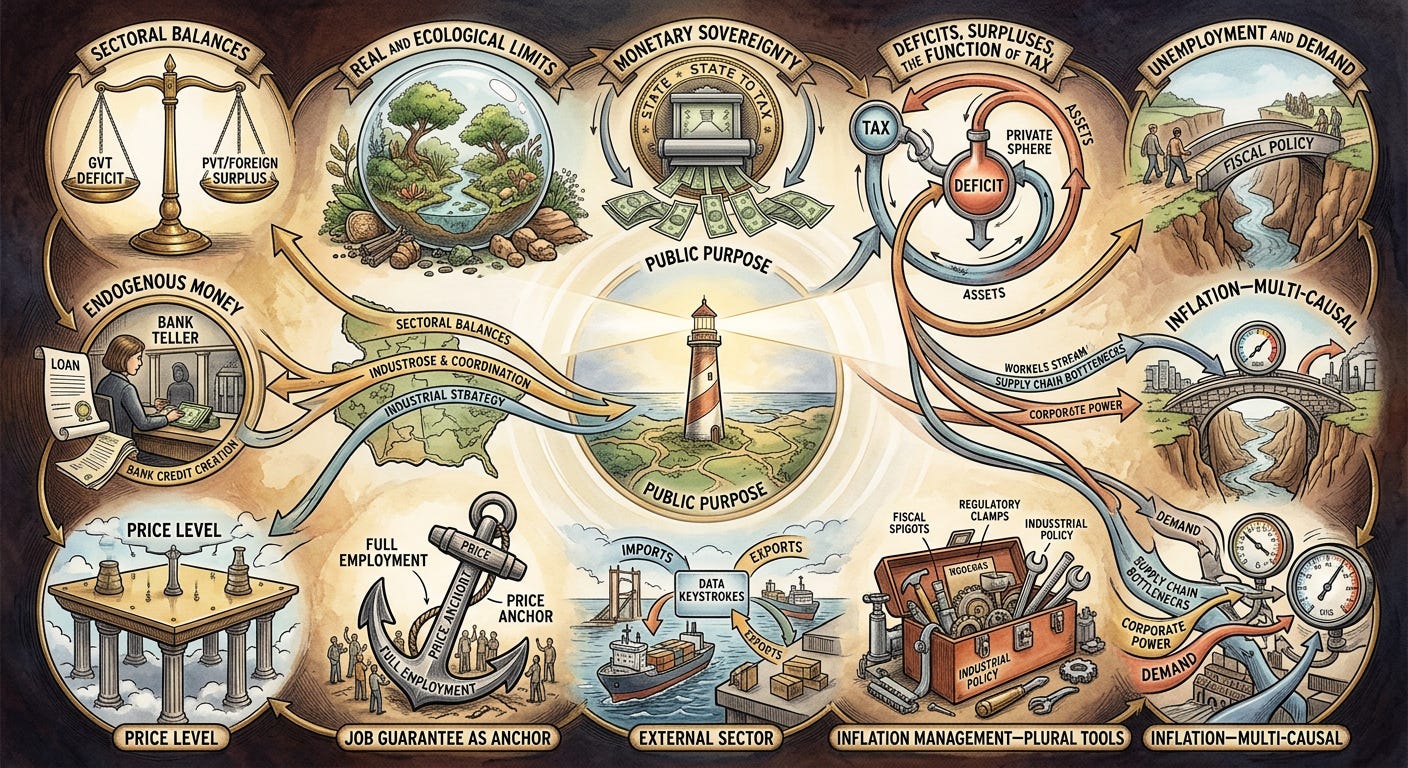
On Language, Framing, Conceptual Clarity and Dual Coordination
Economic analysis and policy are shaped by the language and concepts we use. At the deepest level, economic coordination operates through a necessary and persistent tension captured by the Axiom of Dual Coordination (a self-evident, foundational premise):
The fundamental struggle to reconcile the economy’s inherent requirements for stability and legitimacy with its demand for dynamic adjustment and efficiency.
This duality manifests across three integrated domains:
Structural Domain (Stock vs. Flow): Economic systems rely on Stocks (Buffers) for stability, representing accumulated capacity, reserves, and fixed anchors; these stocks are constantly influenced by Flows (Adjustments), which represent dynamic production, consumption, and resource movement.
Think of Stocks as the rigid, fixed plumbing infrastructure of a house, and Flows as the dynamic water pressure moving through it; both are required, but they are constantly in tension.
Institutional Domain (Ceremonial vs. Instrumental): The Ceremonial dimension embodies the entrenched institutional habits, power structures, and rules that conserve social order and legitimacy (often mapping to Stocks). The Instrumental dimension embodies the technical, efficiency-seeking, and problem-solving logic necessary for functional economic operation (often mapping to Flows).
Cognitive Domain (Rules vs. Utility): This dualism reflects the cognitive imperative to balance non-fungible Rules/Principles (collective provisioning) against fungible Utility/Price signals (individual optimisation).
Key terms, such as “growth,” “sufficiency,” “scarcity,” and “public purpose”—carry contested meanings precisely because they reflect this fundamental struggle to align the stable, rule-bound structures (Ceremonial/Stock) with the dynamic, efficiency-driven functions (Instrumental/Flow).
Clarity, reflexivity, and explicit contextualisation of terminology are essential for productive dialogue. Frameworks must make these underlying duality and power dynamics transparent, and foreground the persistent institutional struggle over how the fixed structures of the economy adapt to the necessary dynamism of real resource flows.

12 Analytical Entry Points for a Modern Monetary Framework
1. Sectoral Balances
The government’s deficit is, by accounting identity, the non-government sector’s surplus; all sectoral financial positions sum to zero. The composition of these balances—across domestic private and foreign sectors—matters for analysis and policy.
2. Real and Ecological Limits
Government spending is constrained by real and ecological limits, not by financial limits; inflation and resource use—not deficits or debt—are the key risks. Ecological and productive capacity boundaries must be respected, regardless of financial arrangements.
3. Monetary Sovereignty
Monetary sovereignty is anchored in the state’s power to impose tax liabilities, which drives demand for the currency. Consequently, currency-issuing governments with floating exchange rates face no financial constraint on spending, only real resource and chosen institutional limits. Fixed or managed exchange rates surrender this sovereignty by introducing external constraints.
4. Deficits, Surpluses, and the Function of Tax
Taxes do not fund spending; rather, they release real resources by regulating non-government purchasing power. Therefore, government deficits create net financial assets for the private sector, thereby enabling both macroeconomic stabilisation and industrial development. Public debt is simply the record of money issued but not yet taxed back; its limit is inflation, not insolvency.
5. Unemployment and Demand
Unemployment signals insufficient spending; fiscal policy should be used to achieve full employment, subject to real resource limits. Full employment includes consideration of job quality, underemployment, and involuntary part-time work.
6. Inflation—Multi-Causal and Contextual
Inflation has multiple, interacting causes and distributional impacts. Its measurement is imperfect and context-dependent, requiring plural indicators and careful diagnosis.
7. Inflation Management—Plural Tools
Inflation is best managed through a combination of fiscal, regulatory, industrial policy, and institutional tools, coordinated to address the specific drivers and distributional impacts. Effective communication, social dialogue, and targeted interventions are often crucial.
8. External Sector and Policy Space
A nation’s external balance reflects real and financial flows; for monetary sovereigns, external deficits are not inherently constraining, but persistent imbalances may signal structural issues and can limit policy space. Fundamentally, exports are real costs and imports are real benefits. A trade deficit means receiving tangible physical wealth in exchange for digital keystrokes. External vulnerabilities are context-dependent and require ongoing assessment and evaluation.
9. Job Guarantee as Anchor
Because the state deliberately creates a need for the currency (unemployment) through taxation, a public Job Guarantee is the necessary logical conclusion of the system. It provides an automatic stabiliser, price anchor, and buffer stock, supporting full employment and price stability. It acts as the primary vehicle for a Just Transition, shielding the environment from the destructive ‘growth-at-all-costs’ imperative by transitioning liberated labour directly toward socially and ecologically regenerative activities. Design and implementation details are critical for effectiveness.
10. Price Level and Currency Value
The general price level and currency value are shaped by government pricing, tax obligations, institutional arrangements, real resource availability, expectations, and power dynamics; government spending and taxation initiate and sustain the currency circuit. The government’s role as price setter is context-dependent.
11. Endogenous Money and Credit
Banks create money endogenously, constrained by capital and collateral, not reserves, while the central bank accommodates liquidity to manage interest rates. Stability requires macroprudential regulation to address leverage and asset cycles; thus, both horizontal (bank) and vertical (state) money are essential for analysis.
12. Public Purpose, Sectoral Balances and Public Coordination
The ontological function of fiscal policy is to advance democratically-determined Public Purpose, which serves as the foundational Institutional Anchor (Stock) of the economy. This purpose is pursued by directing Policy Flows using guides such as sectoral balances, industrial strategy, and social indicators as dynamic tools rather than rigid targets. This Institutional Anchor is necessarily contested terrain, as its definition determines the nature of the economic structure, including which institutional power and social habits are preserved or transformed.
The Economics of Dignity
Modern Money Theory “Starter Pack” eBook

Best for: Those waking up to the reality of monetary sovereignty.
This is the book that flips the script on mainstream economics. It explains the ”Musical Chairs” of unemployment, why the Australian Dollar is a tax credit, and why the deficit isn’t what you think it is. Stop guessing how the system works and read the manual.
You Will Discover: Why unemployment is a deliberate policy choice (the NAIRU), not a personal failing.

If you enjoyed this post, please consider buying me a coffee by pressing the button below.
